
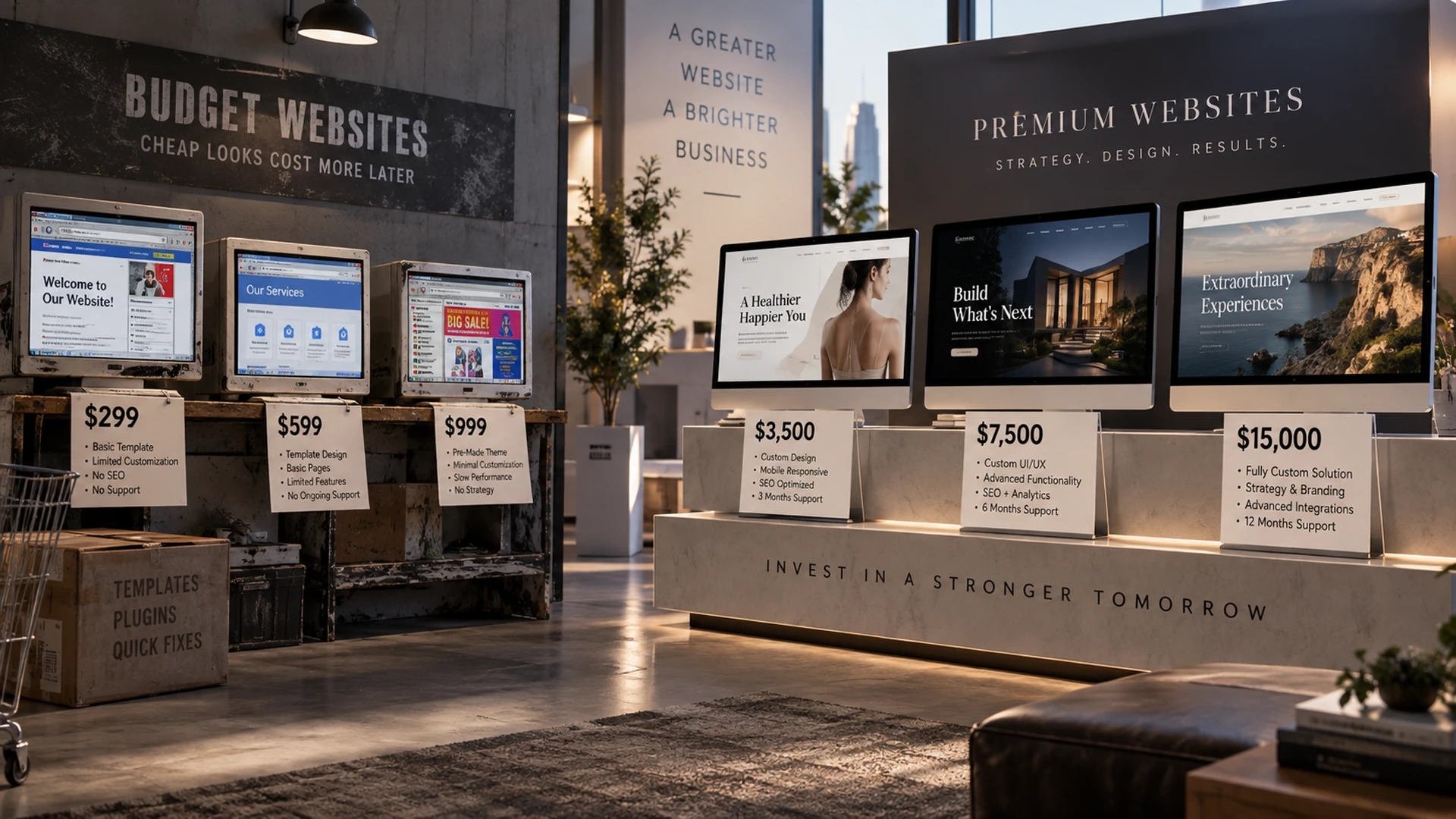
If you’ve started looking for a web designer in Los Angeles, you’ve probably discovered something frustrating almost immediately:
One designer may quote $1,500. Another agency may quote $8,000. A larger studio might come back with $25,000 or more—for what, at first glance, appears to be the same website.
So, how much does a website actually cost in Los Angeles in 2026?
For most small and mid-sized businesses, a professionally designed website will typically require a budget somewhere between $3,000 and $20,000, depending on the design, number of pages, content requirements, functionality, platform, SEO strategy, integrations and level of customization involved.
More sophisticated e-commerce, corporate, membership, booking and custom software projects can easily move beyond that range.
The important question therefore isn’t simply, “How much does a website cost?”
A better question is:
This guide breaks down realistic Los Angeles web design pricing, what affects the cost and how to decide what level of investment makes sense for your business.
Quick Answer: Web Design Cost in Los Angeles in 2026
Here are useful planning ranges rather than fixed industry prices:
| Website Type | Typical Planning Budget |
|---|---|
| DIY / Template Website | $300–$1,500+ |
| Simple Landing Page | $1,500–$4,000 |
| Small Business Website | $3,000–$10,000 |
| Custom Marketing Website | $7,500–$20,000+ |
| E-Commerce Website | $5,000–$30,000+ |
| Corporate Website | $10,000–$40,000+ |
| Custom Web Application | $25,000–$100,000+ |
These ranges are intentionally broad.
A five-page informational website for a local contractor has very different requirements from a healthcare organization, law firm, real estate company, hospitality brand or e-commerce business processing hundreds of transactions every day.
That is why professional web design is usually priced around scope and business requirements, not simply page count.
If you’re looking for a more specific estimate, Brainbox provides web design services in Los Angeles based on the actual requirements of each project rather than forcing every business into the same package.
Why Website Prices Vary So Much
A website isn’t a standardized product.
You can buy two cars with four doors, four wheels and five seats that cost dramatically different amounts. Websites work much the same way.
Two sites may both contain ten pages, yet the amount of strategy, design, development and technology behind those ten pages can be completely different.
1. Template Design vs. Custom Web Design
One of the largest pricing differences comes from how much of the website is actually designed specifically for your business.
A template-based website may begin with an existing WordPress, Webflow, Shopify, Wix or Squarespace framework.
- Existing layouts are adapted to your company
- Colors and typography are customized
- Your logo and imagery are added
- Content is inserted into predefined structures
- Development time is usually reduced
For a small business that primarily needs a polished online presence, this can be perfectly appropriate.
A custom website, however, starts with the business rather than an existing visual structure.
- Brand positioning
- Target audience
- Competitor research
- User behavior
- Customer journeys
- Content hierarchy
- Conversion goals
- Visual identity
- Mobile behavior
- Custom functionality
Wireframes and interfaces are then created specifically around those requirements.
That additional strategy and design work increases the investment, but it also creates something considerably harder for competitors to imitate.
You can read more about this in our article on why custom design can outperform repetitive AI and template-driven web design.
2. Number of Unique Page Designs
“Ten pages” does not necessarily mean ten unique page designs.
A website might contain:
- Home
- About
- Services
- Service Detail
- Industries
- Industry Detail
- Portfolio
- Project Detail
- Blog
- Article
- Contact
Several pages may share the same underlying template.
For example, a company with 20 individual service pages may only need one flexible service-page system that is reused through the CMS.
On the other hand, a highly editorial website may require almost every major page to have a unique composition.
The more unique layouts that need to be researched, wireframed, designed, developed and tested, the larger the project becomes.
3. UI/UX Strategy
Good web design isn’t simply graphic design placed inside a browser.
A professional website should answer questions such as:
- What does the visitor need to understand first?
- Where should they go next?
- Which information reduces uncertainty?
- What prevents them from contacting the business?
- What creates trust?
- Which action represents a successful conversion?
This process is part of user experience design, or UX.
Depending on the project, UX work can include competitor research, customer research, information architecture, user journeys, wireframes, navigation planning, conversion strategy, prototyping and usability testing.
For simple websites, this process may be relatively lightweight. For complex digital products, it can become one of the most important parts of the project.
Brainbox’s broader design and digital services combine branding, UI/UX, web design, development and digital strategy rather than treating a website purely as visual decoration.
4. Branding
Sometimes a company doesn’t actually have a website problem.
It has a brand problem that becomes obvious when someone starts designing the website.
A business may already have a logo but no clearly established:
- Color system
- Typography system
- Photography direction
- Iconography
- Messaging
- Brand voice
- Visual hierarchy
In that situation, simply redesigning the website may result in attractive pages without creating a coherent brand.
A project that includes brand strategy, visual identity or logo development will naturally cost more than a website built around an established brand system.
The advantage is consistency across your website, advertising, social media, packaging, presentations and other brand communications.
5. Content and Copywriting
One of the most underestimated parts of a website project is content.
Someone has to determine what every page actually says.
- Homepage messaging
- Service descriptions
- Company positioning
- Calls to action
- Case studies
- FAQs
- Team biographies
- Product descriptions
- SEO landing pages
- Blog content
If you’re providing finalized copy, photography and video, the project may move considerably faster.
If the agency needs to research, write and produce those assets, the scope changes.
6. Photography, Illustration, Video and 3D
Visual content can dramatically change how a company is perceived.
There is a significant difference between filling a site with generic stock photography and developing a coordinated visual system specifically for the brand.
Depending on the project, that might include:
- Creative direction
- Commercial photography
- Video production
- Custom illustration
- Animation
- Motion graphics
- Custom iconography
- 3D rendering
- Product visualization
For businesses where trust, visual quality or differentiation matter, these assets can become some of the strongest parts of the entire website.
7. WordPress, Shopify, Webflow or Custom Development
The technology behind your website also affects development cost.
Different platforms solve different business problems.
WordPress
WordPress remains an excellent choice for many marketing and content-driven websites because companies can easily manage pages, articles, images and other content.
It can work especially well for:
- Professional services
- Healthcare
- Construction
- Legal businesses
- Education
- Hospitality
- Corporate websites
- Local businesses
For example, you can view Brainbox’s Athella Home Health website project, which combines a custom visual system with WordPress development and an SEO-ready structure.
Shopify
Shopify is often a strong choice when selling products is the primary purpose of the website.
Pricing may depend on:
- Number of products
- Product variations
- Subscription functionality
- Wholesale accounts
- Shipping requirements
- Inventory systems
- Custom checkout requirements
- Third-party integrations
Custom Development
Once you introduce functionality such as customer dashboards, booking systems, marketplaces, calculators, membership portals, custom databases or complex APIs, you may no longer be pricing a traditional website.
You’re pricing software.
That can move the budget significantly.
8. E-Commerce Complexity
One online store isn’t necessarily comparable to another.
A business selling ten simple products has very different requirements from one managing thousands of SKUs across multiple warehouses.
An e-commerce project may require:
- Shopify or WooCommerce configuration
- Product migration
- Product variants
- Subscription systems
- Wholesale pricing
- Customer accounts
- Inventory integrations
- Advanced shipping logic
- Payment gateways
- ERP or CRM integrations
- Email automation
- Loyalty programs
- Abandoned cart systems
- Reviews
- Conversion tracking
This explains why e-commerce pricing can range from several thousand dollars to tens of thousands—or significantly more for large operations.
9. SEO
If organic search matters to your business, SEO should influence the website before development begins, not after launch.
A search-friendly website needs thoughtful:
- Page hierarchy
- URL structure
- Heading hierarchy
- Content architecture
- Internal linking
- Metadata
- Schema markup
- Image optimization
- Mobile performance
- Page speed
- Crawlability
- XML sitemaps
- Analytics
- Google Search Console configuration
For local businesses, geographic targeting becomes important as well.
A Los Angeles company may need pages targeting specific services, industries or locations rather than expecting one homepage to rank for every possible search.
What Different Website Budgets Can Realistically Buy
What Does a $1,500 Website Look Like?
At this level, you’re generally looking at a relatively small project.
- Approximately 3–5 pages
- Existing template or design system
- Responsive layout
- Contact form
- Basic CMS configuration
- Basic on-page SEO
- Content provided by the client
For a new business that mainly needs credibility when someone searches its name, this can be completely reasonable.
Not every company needs an enormous custom website.
What Does a $3,000–$7,500 Website Look Like?
This is where many professional small-business websites begin becoming more strategic.
- Custom homepage design
- Customized internal pages
- Improved UX
- WordPress development
- Responsive optimization
- Better visual hierarchy
- SEO-ready structure
- Analytics setup
- Performance optimization
- Lead-generation forms
- Basic integrations
For many local professional-service businesses, this range can produce a very strong website when the scope remains focused.
What Does a $7,500–$15,000 Website Look Like?
At this level, the project can become considerably more customized.
- Discovery and strategy
- Custom UI/UX design
- Multiple unique page layouts
- Advanced responsive behavior
- Custom content architecture
- SEO research
- Conversion planning
- Copywriting support
- Custom graphics
- Animation
- Business integrations
- CMS customization
- Browser and device QA
This range often makes sense for businesses where the website plays an important role in sales, reputation or lead generation.
What Does a $15,000–$30,000+ Website Look Like?
Now we’re usually discussing a substantial digital project rather than a straightforward brochure website.
- Extensive UX strategy
- Sophisticated branding
- Large content architecture
- Custom photography or video
- Advanced animation
- E-commerce systems
- Multilingual content
- CRM integrations
- Customer accounts
- External APIs
- Advanced SEO
- Accessibility requirements
- Complex forms
- Data migration
- Custom backend development
What About $50,000–$100,000+ Websites?
They absolutely exist.
But the price usually isn’t because somebody made the buttons prettier.
Large digital projects can involve:
- Hundreds or thousands of pages
- Multiple stakeholder groups
- Custom web applications
- Enterprise infrastructure
- Accessibility audits
- Cybersecurity requirements
- Complex third-party integrations
- User testing
- Custom databases
- API architecture
- Multilingual systems
- Legacy-platform migration
- Internal business workflows
- Ongoing development teams
At that point, comparing the project to a $5,000 small-business website isn’t particularly meaningful.
You’re comparing different products.
Freelancer vs. Web Design Agency: Why Prices Differ
Working With a Freelancer
A talented freelancer can be an excellent option.
Potential advantages include:
- Lower overhead
- Direct communication
- Lower overall cost
- Flexibility
- Deep specialization in a specific discipline
The potential limitation is capacity when a project simultaneously requires strategy, branding, UX, design, development, SEO, content and ongoing technical support.
Working With a Web Design Agency
An agency generally brings multiple disciplines together under one roof.
- Strategy
- Brand design
- UX
- UI design
- Development
- Copywriting
- SEO
- Photography and video
- Project management
That broader capability generally costs more.
But ideally, you’re not simply paying for more people. You’re paying for coordination between specialties.
The designer understands what the developer needs. SEO influences the content structure. The brand system guides the interface. Technology decisions account for future growth.
Is a Cheap Website Automatically a Bad Website?
Not necessarily.
And an expensive website isn’t automatically good.
The important question is whether the solution matches the objective.
Imagine a consultant who needs only:
- Home
- About
- Services
- Contact
If the business already has excellent branding, strong photography and finalized content, a simple site may be all it needs.
Now compare that with a healthcare organization requiring multiple locations, dozens of services, multilingual pages, accessibility, recruiting, patient resources, SEO, analytics and CRM integration.
Trying to solve both problems with the same $1,500 website package does not make sense.
Don’t Judge Website Quotes Only by Page Count
This is one of the most important things to remember when comparing web design proposals.
Imagine receiving three estimates:
Agency B: 10-page website — $9,000
Agency C: 10-page website — $18,000
You cannot determine which one offers the best value without understanding what each scope includes.
Ask whether the proposal includes:
- Research
- Strategy
- Wireframing
- Custom UI design
- Responsive design
- Development
- CMS configuration
- Copywriting
- Content entry
- SEO
- 301 redirects
- Schema markup
- Analytics
- Google Search Console
- Accessibility work
- Performance optimization
- Testing
- Launch
- Training
- Post-launch support
You may discover that the three agencies aren’t actually quoting the same project at all.
Hidden Website Costs You Should Ask About
The initial website build isn’t always the only cost.
Domain Registration
Domain registration is generally inexpensive, but make sure you know who controls it.
Hosting
Hosting costs vary depending on traffic, performance requirements, server infrastructure, backups and security.
Premium Plugins and Applications
WordPress plugins, Shopify apps and third-party software may charge monthly or annual subscription fees.
Website Maintenance
Professional websites usually require ongoing:
- Software updates
- Backups
- Security monitoring
- Compatibility checks
- Bug fixes
- Technical support
SEO
Building an SEO-ready website and running an ongoing SEO campaign are two different services.
Content Production
Ask whether copywriting, photography, illustration, image sourcing and video are included in the proposal or priced separately.
Future Changes
Find out how support works after launch and whether future work is billed hourly, through a maintenance plan or as separate projects.
How Much Should a Small Business Spend on a Website?
There isn’t a universal percentage.
Instead, consider the website’s economic role within your business.
If the website primarily exists to confirm that your company is legitimate, your budget may be relatively modest.
If one new client is worth $20,000 to your company and the website generates qualified leads every month, investing $10,000–$20,000 in a stronger digital presence may be completely rational.
For an e-commerce company, restaurant or booking-based business, the website may directly process revenue.
For a law firm, medical practice or professional-services company, the site may strongly influence whether a prospect contacts the business at all.
Should You Use Wix, Squarespace or an AI Website Builder Instead?
Sometimes, yes.
A DIY platform may be appropriate when:
- The business is brand new
- The available budget is extremely limited
- The website isn’t a major acquisition channel
- The required functionality is simple
- Speed of launch matters more than differentiation
Website builders are considerably more capable than they were ten years ago, and AI has accelerated that development even further.
You can now generate a technically functional site extremely quickly.
The limitation appears when the question changes from:
to
“Can I create a website that makes my business meaningfully different?”
That usually requires stronger brand thinking, customer understanding, messaging, UX and creative direction.
How Long Does Professional Web Design Take?
A relatively simple website may launch within several weeks. A larger custom project may take several months.
A typical professional process can include:
- Discovery
- Research
- Content planning
- Information architecture
- Wireframing
- UI design
- Responsive design
- Development
- Content entry
- SEO implementation
- Quality assurance
- Launch
The biggest project delays are often not technical.
They usually come from waiting for content, approvals, photography, legal information, product data or stakeholder feedback.
Having those materials organized before development begins can significantly reduce the timeline.
How to Compare Los Angeles Web Design Companies
Review Their Actual Work
Does the agency show real completed projects?
Do different clients receive different creative solutions, or does every website feel essentially identical?
Look for Strategic Thinking
A good web designer should be able to explain why something should be structured or designed a certain way—not simply whether it looks attractive.
Ask Who Actually Does the Work
Some agencies sell locally but outsource most production.
Outsourcing itself isn’t necessarily a problem. Lack of creative oversight and accountability is.
Discuss SEO Before Development
SEO shouldn’t suddenly become a conversation three days before the site goes live.
Clarify Ownership
Make sure ownership is clearly defined for:
- Domain name
- Hosting
- Website files
- Design assets
- CMS accounts
- Analytics accounts
- Third-party services
Ask About Post-Launch Support
A professional website relationship shouldn’t necessarily end the moment the site goes live.
Why Los Angeles Businesses Need More Than a Pretty Website
Los Angeles is an unusually competitive market.
A potential customer may be choosing between dozens—or hundreds—of businesses offering similar services.
That makes differentiation important.
Your website needs to communicate quickly:
- Who are you?
- What do you do?
- Why should someone trust you?
- Why should they choose you instead of a competitor?
- What should they do next?
Visual design matters because perception matters.
But effective web design combines visual quality with positioning, messaging, UX, speed, content, SEO, accessibility and conversion strategy.
The result should be more than an online brochure.
Frequently Asked Questions About Web Design Cost in Los Angeles
How much does a basic website cost in Los Angeles?
A basic professionally produced small-business website may start around $2,000–$5,000, depending on whether it uses an existing design system, how much content is required and who builds it. Very simple template-based projects can cost less.
How much does a custom website cost?
A professionally designed custom marketing website may commonly require approximately $5,000–$20,000+. Complex functionality, extensive content, custom integrations or advanced creative work can move the budget considerably higher.
How much does an e-commerce website cost?
A professionally developed e-commerce website might begin around $5,000 for a relatively straightforward store and rise to $20,000–$30,000+ as custom functionality, integrations and catalog complexity increase. Large e-commerce platforms can cost substantially more.
Is WordPress cheaper than custom development?
Usually. WordPress already provides a powerful content-management foundation, so developers don’t need to create every administrative feature from scratch. However, a highly customized WordPress website can still require substantial design and development work.
How much should a small business spend on a website?
For many established small businesses, $3,000–$10,000 is a useful initial planning range. However, the appropriate investment should ultimately be based on how important the website is to lead generation, sales, reputation and customer acquisition.
Why do some agencies charge $20,000 or more for a website?
Because the fee may include considerably more than page production. Strategy, research, UX, custom design, branding, content development, SEO, development, testing, integrations and project management all require specialized work.
Can I build my own website for less?
Absolutely. Platforms such as WordPress, Shopify, Squarespace, Wix and AI website builders have made basic website creation accessible to almost anyone. The trade-off is usually time, customization, strategy and differentiation.
How do I get an accurate website estimate?
Prepare a project brief containing your business goals, approximate page count, required functionality, examples of websites you like, integrations, existing branding, available content, target launch date and approximate budget. A professional agency can then define the scope and provide a realistic proposal.
So, How Much Should Your Website Cost?
There is no single correct price.
A startup needing a five-page informational website should not pay the same amount as a national company building a custom digital platform.
And a $30,000 website isn’t automatically better than a $5,000 website.
The right investment is the amount required to solve the actual business problem properly.
Before comparing prices, define:
- What the website needs to accomplish
- Who it needs to convince
- What functionality it requires
- How customers will find it
- How important it is to the company’s growth
Once those answers are clear, website pricing becomes much easier to understand.
Planning a Website Project in Los Angeles?
Brainbox designs and develops websites around the actual requirements of each business—from focused small-business websites to custom digital experiences, e-commerce platforms and sophisticated web applications.
If you’re considering a new website or redesign, contact Brainbox for a project estimate →
